Kureba kweSesheni neMutengo
Kuti mari yekutamba inogara kwenguva yakareba sei pamari yakabhejwa yakapihwa, uye kuti maawa anodhura zvakadii. Nhamba dzisingamboverengwi nevatambi vazhinji asi dzinofanira kuverengwa nevazhinji.

Kubheja kwakaenzana pamubhadharo wakaenzana kunogara, paavhareji, kutenderera 37 pamari yakabhejwa yega yega iri mumari yekutamba, kunyange hafu yemasesheni ese ichipera nekukurumidza kupfuura ipapo; mutengo unotarisirwa paawa imari yakabhejwa × kutenderera paawa / 37. Pamwe chete zvinokubvumirai kuisa mutengo pamanheru asati atanga.
Kuti mari yekutamba inogara kwenguva yakareba sei
Assume standard single-zerovhiriZeroGomba rimwe chete rakasvibira risingafukidzwi nebheti remubhadharo wakaenzana, redozeni kana rekoramu; ndiko kunobva chikamu chekasino. Mamwe mazita: zero imwe, 0.Verengai zvese → rules, independent spinsmasvomhuKutenderera kwakazvimiriraKutenderera kwega kwega kune mikana imwe chete zvisinei nezvakaitika kare. Ihwo hwaro hwekuverenga kwese pawebhusaiti ino.Verengai zvese →, a fixed stake s, a bankrollmariMari yekutambaMari yose yakachengeterwa kutamba. Kutonga mari yekutamba kuri kusarudza kuti mungaisa pangozi yakawanda sei pabheti rimwe nepasesheni imwe.Verengai zvese → B that is an integer multiple of s, and play continuing until the balance reaches zero. With these assumptions, the bankroll drifts down by s/37 a spin on average and swings by about s a spin either way. The drift alone sets the average: the bankroll lasts 37 × B/s spins, since that is how long it takes to lose B at s/37 a spin. The swings make the lengths uneven. Some sessions die early on a bad run, a few last far longer, and the median, the length half of all sessions fail to reach, sits below the average. A $500 bankroll at $10 (B/s = 50) lasts 1,850 spins on average and 1,364 at the median, about 27 hours at an illustrative 50 spins per hour. At $50 (B/s = 10) the median is 136 spins, under three hours.
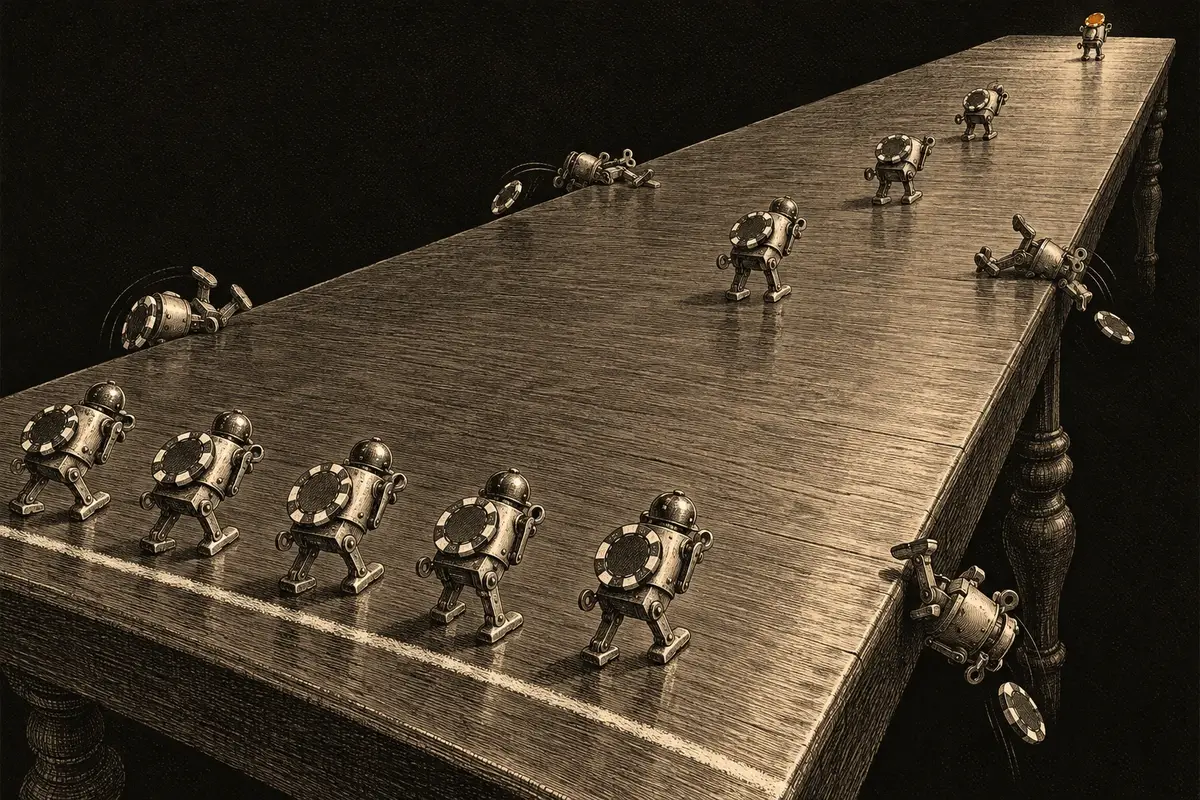
Zvinodhura maawa
Expected lossmasvomhuKurasikirwa kunotarisirwaKukosha kunotarisirwa kwakapetwa nemari yose yakabhejwa; mari yepakati inorasika musesheni kana munguva yakati.Verengai zvese → per hour = stake × spins per hour / 37. The two numbers you control are the stake and the pace. If all planned spins are played, $10 standard single-zero bets at 50 spins per hour have an expected hourly loss of $13.51. La partagemutemoLa partageMutemo wechiFrench: kana zero yabuda, hafu yemari yakabhejwa pabheti remubhadharo wakaenzana inodzoserwa. Inoita hafu chikamu chekasino pamabheti iwayo kusvika pa1.35%.Verengai zvese → on eligible even-money betsbhetiBheti remubhadharo wakaenzanaTsvuku/nhema, isina kuenzana/yakaenzana, dzepamusoro/dzepasi. Nhamba 18, rinobhadhara 1:1.Verengai zvese → reduces that to $6.76. Doubling the pace to 100 spins per hour doubles the standard expected loss to $27.03. These are averages, not hourly fees or loss limits.
Kuzvibatanidza
Consider $500 for up to 200 standard single-zero redbhetiTsvukuBheti remubhadharo wakaenzana panhamba 18 tsvuku. ChiFrench: rouge.Verengai zvese → bets. At a fixed $25 stake, the chance of reaching zero within those spins is about 25.9%. A median ruin time of 394 spins therefore does not make a 200-spin session safe. If play stops at ruin or after 200 spins, expected turnovermariMari yose yakabhejwaMari yese yakabhejwa musesheni kana munguva yakati, kusanganisira mari yakakundwa yakabhejwazve. Mamwe mazita: handle, action.Verengai zvese → gives an expected loss of about $122.52; $135.14 is the figure assuming all 200 bets are made. At a $10 stake, the ruin probabilitymasvomhuMukanaMukana wemhedzisiro, kubva pa0 kusvika pa1 kana 0% kusvika 100%. Nhamba imwe: 1/37 = 2.70%.Verengai zvese → falls to about 0.143%, with an expected loss of about $54.05. Choose stakes within a loss budget; none of these figures guarantees survival.
- p10 −$500
- p25 −$500
- median −$500
- p75 −$50
- p90 +$350
Masesheni estraight up
A straight-up bet has much greater variability per unitmariYunitiMari yehwaro inoshandiswa nesisitimu kana nemutambi. Maprogression anotsanangurwa nemayuniti kuitira kuti ashande patafura ipi zvayo.Verengai zvese → staked than red: standard deviationmasvomhuStandard deviationMudzi wesikweya wemusiyano; chinhambwe chakajairwa chemhedzisiro kubva pakukosha kunotarisirwa.Verengai zvese → about 5.84 units versus 1. Over a 200-spin single-zero session, a bankroll of 13 fixed red stakes has about a 49.1% chance of ruin. For one straight-up number, 56 stakes gives about 52.7% ruin and 57 stakes about 47.5%. These comparisons depend on the horizon and bet; there is no universal four-times-bankroll rule. With only 20 straight-up stakes, the first 20 spins all miss about 57.8% of the time, ending the session immediately.
Rondedzero yemitengo yechokwadi
Roulette inodhura mari yakabhejwa × kutenderera / 37. Zvimwe zvese, sisitimu, nhamba yerombo, kuzvidzivirira, zvinosarudza chimiro chemanheru kwete mutengo wawo. Mutambi anotanga kuverenga mutengo osarudza mari yakabhejwa yaanofara kubhadhara aita chikamu chimwe chete chenzira chinoshanda.
Fomula
Mibvunzo
Kwete yakanyatsojeka. Pamari yekutamba shoma kuzununguka kunotonga uye median inokura zvinenge se(B/s)², sepamari yesimbi yakaenzana. Pamari yakawanda chikamu chekasino chinotonga uye median inoswedera kuavhareji, 37 × B/s. Pamari dzinenge 20 dzakabhejwa mutemo we(B/s)² unoitika kuenderana nemedian chaiyo, kutenderera 394; pasi ipapo unopfupika uye pamusoro unorebesa.
Stopping reduces expected turnover and therefore expected loss. A stated stop-lossnziraMuganho wekurasikirwaHuwandu hwekurasikirwa hwakatarwa pamberi apo munopedza sesheni.Verengai zvese → can be exceeded by the final losing bet unless the remaining allowance limits that stake. It does not improve the odds of the bets already placed.
La partage halves expected loss per eligible even-money bet. Dividing bankroll by the mean loss per full stake suggests 74 × B/s spins, but this is not an exact session-length formula: half-losses can leave less than a full stake, and table minimums or smaller final bets change the stopping process.
Kutamba neMasvomhu
Edzai izvi imi pachenyu pekutanga. Mhinduro yega yega yakapetwa; ivhurei kana magadzirira.
Start with $500 and bet $10 on redbhetiTsvukuBheti remubhadharo wakaenzana panhamba 18 tsvuku. ChiFrench: rouge.Verengai zvese → on each independent, uniform single-zerovhiriZeroGomba rimwe chete rakasvibira risingafukidzwi nebheti remubhadharo wakaenzana, redozeni kana rekoramu; ndiko kunobva chikamu chekasino. Mamwe mazita: zero imwe, 0.Verengai zvese → spin. Stop only when the bankrollmariMari yekutambaMari yose yakachengeterwa kutamba. Kutonga mari yekutamba kuri kusarudza kuti mungaisa pangozi yakawanda sei pabheti rimwe nepasesheni imwe.Verengai zvese → reaches zero, with no upper target and a bank that can always pay. How many spins does the bankroll last on average?
Ratidza mhinduro
Mhinduro Kutenderera 1,850: kutenderera 37 pamari yakabhejwa imwe neimwe pa50.
Each spin costs, on average, 1/37 of the stake: $10/37, about 27 cents. The bankroll holds 50 stakes, and losing 50 stakes at 1/37 of a stake a spin takes 50 × 37 = 1,850 spins.
The swings do not change this average, because a session can only end at zero and every spin before that costs the same 27 cents on average. They change the spread: half of all sessions are over by spin 1,364, and about one in twenty runs past 5,000, which pulls the average up.
For this fixed-stake even-money random walk, with no upper boundary, the mean time to zero is the initial number of stakes divided by the house edgemasvomhuChikamu chekasinoChikamu chemari yega yega yakabhejwa chinochengetwa nekasino paavhareji: 2.70% muRoulette yeEurope.Verengai zvese →. On a standard double-zero wheel the same $500 bankroll at $10 per spin therefore lasts 50 ÷ (2/38) = 950 spins on average. A time limit, profit target or changing stakes defines a different stopping problem.
Kuseka zvishoma
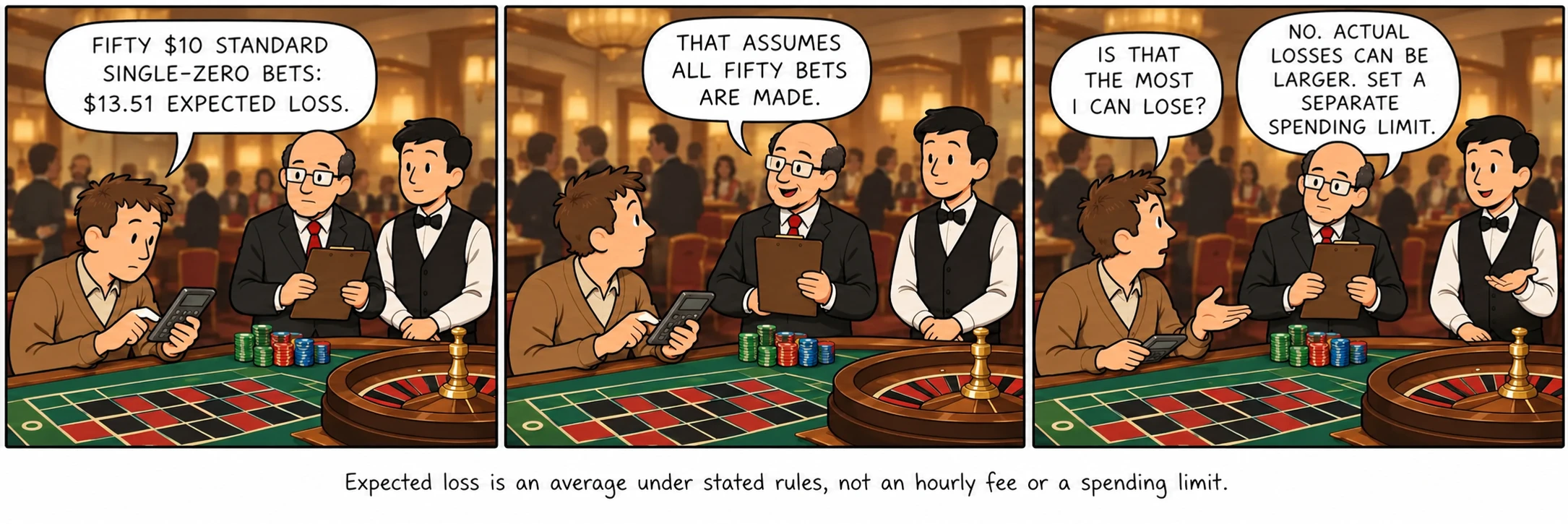
Mari yakabhejwa × kutenderera / 37. Isai mutengo pamanheru asati atanga.
Zvinyorwa
- Feller, W. An Introduction to Probability Theory and Its Applications, Vol. 1.
- Ethier, S. N. The Doctrine of Chances: Probabilistic Aspects of Gambling.
- Epstein, R. A. The Theory of Gambling and Statistical Logic, 2nd ed.