Nhoroondo yeMasisitimu eRoulette
Mazana maviri emakore evanhu vachinyora mitemo yekuchinja mari yavanobheja.
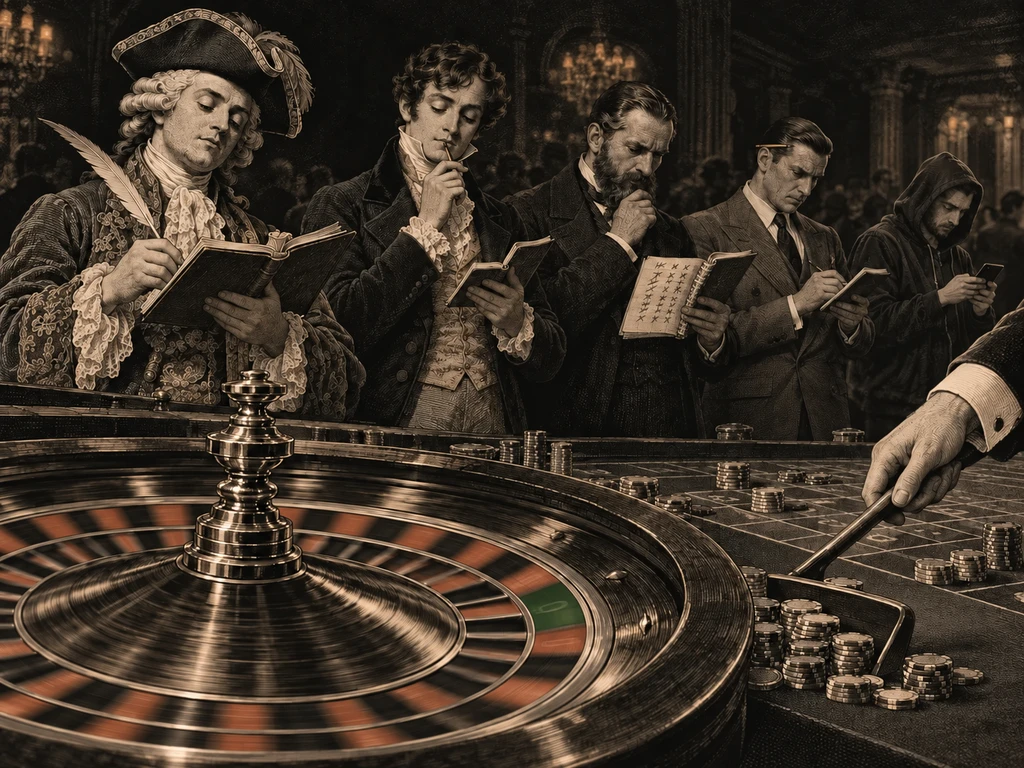
Martingale ndeyezana ramakore rechi18; D’Alembert yakatumidzwa zita renyanzvi yemasvomhu yaisaida; Labouchère yaive chinhu chaifarirwa nemupolitiki wenguva yaVictoria. Hapana neimwe yadzo yakashanda panguva iyoyo zvakare.
Martingale
The 1762 Académie française dictionary records martingalenziraMartingaleProgression inopeta bheti kaviri mushure mekurasikirwa kwega kwega. Onai chikamu cheNzira kuti munzwisise zvainoita nezvaisingaite.Verengai zvese → as a gambling term for staking what has been lost. Its 1878 edition explicitly describes doubling after a loss and also uses the word more broadly for betting schemes. These entries document usage; they do not identify a single inventor.
Today the familiar doubling progressionnziraProgressionMutemo upi zvawo unochinja mari yekubheja zvichienderana nemhedzisiro yakapfuura. Maprogression anokwira mushure mekurasikirwa anoikwidza kana mukarasikirwa; maprogression anokwira mushure mekukunda anoikwidza kana mukakunda.Verengai zvese → aims to recover previous losses and gain one starting unitmariYunitiMari yehwaro inoshandiswa nesisitimu kana nemutambi. Maprogression anotsanangurwa nemayuniti kuitira kuti ashande patafura ipi zvayo.Verengai zvese → when a win arrives. A finite bankrollmariMari yekutambaMari yose yakachengeterwa kutamba. Kutonga mari yekutamba kuri kusarudza kuti mungaisa pangozi yakawanda sei pabheti rimwe nepasesheni imwe.Verengai zvese → or table limittafuraMuganho wetafuraBheti diki nerikuru kupfuura ese anobvumirwa. Rikuru ndiro rinomisa maprogression ekupeta kaviri.Verengai zvese → can stop the sequence first. The Strategy section shows how those limits affect a session.
D’Alembert
The progression bearing d’Alembert’s name raises the stake by one unit after a loss and lowers it after a win. The name alone does not prove who devised or endorsed the betting rule.
Its mathematical issue is straightforward: on independent spinsmasvomhuKutenderera kwakazvimiriraKutenderera kwega kwega kune mikana imwe chete zvisinei nezvakaitika kare. Ihwo hwaro hwekuverenga kwese pawebhusaiti ino.Verengai zvese →, a run of one outcome does not make the opposite outcome due. A famous namesake does not change that assumption or the payoutmariMubhadharoZvinodzoserwa nebheti rakunda, zvinotaurwa se“X kusvika ku1” pamusoro pemari yakabhejwa inodzoserwa.Verengai zvese →.
Labouchère
The cancellation system uses a list of numbers to determine the next stake. A win removes entries and a loss adds an entry; the Strategy section sets out the rules and examples. Historical stories about its namesake should be distinguished from evidence that the method creates an advantage.
A sequence may clear with a profit, but a losing run can leave a growing list and larger required stakes. How often it clears depends on the starting list, bankroll, limits and stopping rule. There is no universal success percentage.
Zana ramakore rechi20
A simulation can show how a specified system behaves under a chosen wheel model. It cannot test every possible rule, and a finite run need not return exactly the theoretical house edgemasvomhuChikamu chekasinoChikamu chemari yega yega yakabhejwa chinochengetwa nekasino paavhareji: 2.70% muRoulette yeEurope.Verengai zvese →.
For independent uniform single-zerovhiriZeroGomba rimwe chete rakasvibira risingafukidzwi nebheti remubhadharo wakaenzana, redozeni kana rekoramu; ndiko kunobva chikamu chekasino. Mamwe mazita: zero imwe, 0.Verengai zvese → spins with standard full-loss-on-zero payouts, each unit staked has expected net return −1/37. For a bounded session whose stakes are chosen using information available before each spin, adding the conditional expectations gives expected lossmasvomhuKurasikirwa kunotarisirwaKukosha kunotarisirwa kwakapetwa nemari yose yakabhejwa; mari yepakati inorasika musesheni kana munguva yakati.Verengai zvese → equal to 1/37 of expected turnovermariMari yose yakabhejwaMari yese yakabhejwa musesheni kana munguva yakati, kusanganisira mari yakakundwa yakabhejwazve. Mamwe mazita: handle, action.Verengai zvese →. Stopping or changing stakes can change the distribution of results, but not create positive expectation under those assumptions. Other payouts, such as la partagemutemoLa partageMutemo wechiFrench: kana zero yabuda, hafu yemari yakabhejwa pabheti remubhadharo wakaenzana inodzoserwa. Inoita hafu chikamu chekasino pamabheti iwayo kusvika pa1.35%.Verengai zvese →, need their own calculation.
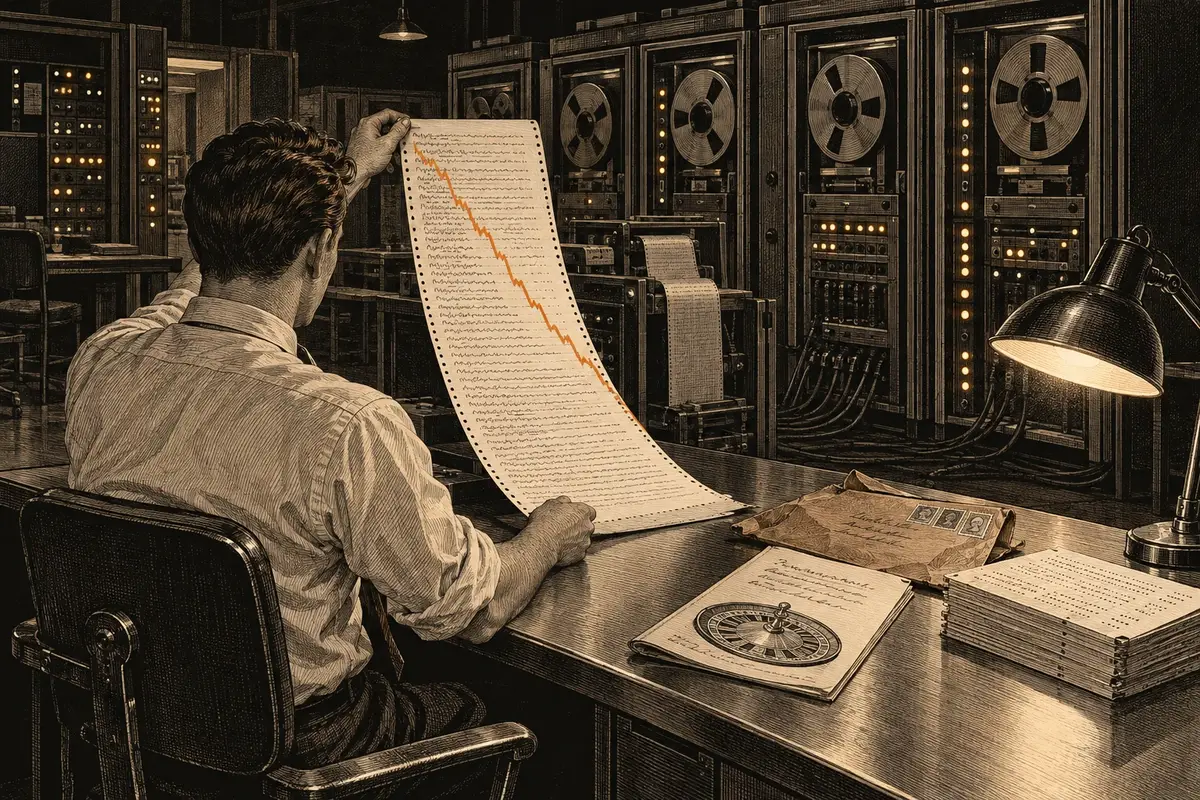
Ngano: Nzira yeRoulette Inogara IchikundaNzira yeFibonacci paRoulette
Sei achiramba aripo
A demonstration can end in profit without showing that the method has an edge. Some rules favor frequent small wins at the cost of occasional large losses; others do the reverse. The proportions depend on the exact rules and limits.
When comparing systems, look at all completed sessions, total stakes, losses and stopping conditions. A selected winning example leaves out the information needed to assess the claim.
Masisitimu anotengeswa
Systems have also been sold with elaborate names and entry rules. The examples below illustrate the arithmetic of specific rules; they are not evidence of who first invented or marketed them. Waiting for a pattern does not alter the next independent spin’s probabilities.
Iyo isiri sisitimu
Mitemo yekumira: kusarudza pachine nguva kuti murasikirwe kana mukunde zvakadii mobva maenda. Kazhinji inotengeswa sechikamu chesisitimu uye ndicho chikamu chega chinoita chimwe chinhu, nekuti inoderedza mari yose yakabhejwa. Haina munhu yakatumidzwa zita rake, izvo zvakakodzera.
Mibvunzo
Martingale, nezana ramakore kana kupfuura. Kupeta kaviri mushure mekurasikirwa ipfungwa yekutanga inouya kumunhu wese.
D’Alembert akasvika pedyo, netsaona. Pascal, Fermat, Huygens, Bernoulli naLaplace vese vakatsanangura kuti sei achikundikana.
Nekuti masesheni mazhinji anokunda, uye vhidhiyo yesesheni yekukunda haidhuri kugadzira.
Kuseka zvishoma
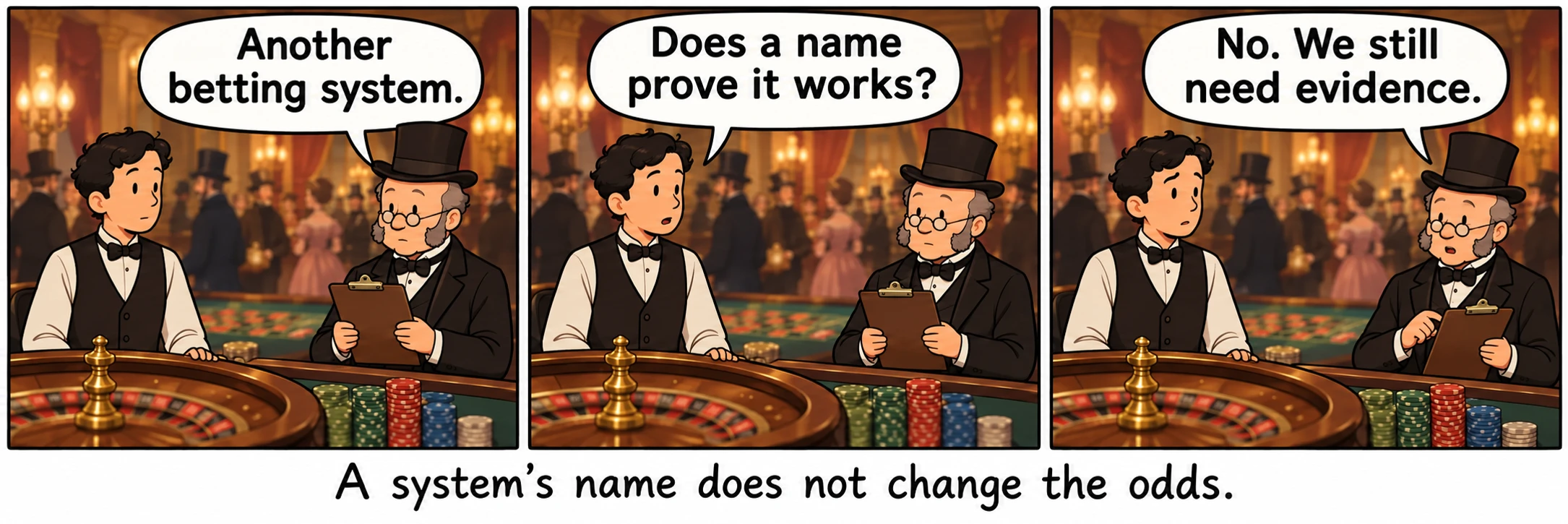
Mazana maviri emakore emazita. Nhamba imwe.
Zvinyorwa
- Thorp, E. O. “Optimal gambling systems for favorable games.”
- Thorp, E. O. The Mathematics of Gambling.
- Doob, J. L. “Note on probability.”
- Halmos, P. R. “Invariants of certain stochastic transformations: the mathematical theory of gambling systems.”
- d’Alembert, J. “Croix ou pile.”
- Schwartz, D. G. Roll the Bones: The History of Gambling.
- Kavanagh, T. M. Dice, Cards, Wheels: A Different History of French Culture.
- Bollman, M. Mathematics of the Big Four Casino Table Games: Blackjack, Baccarat, Craps, & Roulette.
- Académie française, martingale, 1762
- Académie française, martingale, 1878