Kukosha kweNhamba dzeOngororo
“Ine kukosha” zvinoreva kuti hazviwanzoitika pavhiri rakarurama, kwete kuti “ndezvechokwadi” uye kwete kuti “zvinopa purofiti”.

p-value ye0.05 inoreva kuti vhiri rakarurama raizoburitsa maitiro akarerekera zvakadai kamwe chete muna makumi maviri. Kana mukatarisa mavhiri makumi maviri, rimwe richapasa nemhanza.
Chii chinonzi p-value
Assuming the stated null model, the p-valueongororop-valueMukana wekuona kutsauka kwakakura zvakaenzana kana kupfuura kwakaonekwa dai vhiri rakanga rakarurama.Verengai zvese → is the probabilitymasvomhuMukanaMukana wemhedzisiro, kubva pa0 kusvika pa1 kana 0% kusvika 100%. Nhamba imwe: 1/37 = 2.70%.Verengai zvese → of a test statistic at least as extreme as the observed one. It is not the probability that the wheel is fair or that the result arose by chance. Interpretation also depends on the design, assumptions and tests attempted.
Kuenzanisa kwakawanda
Bvunzo yega yega yamunoita pavhiri rakarurama ine mukana we5% wekupasa padanho re5%. Edzai mavhiri makumi maviri uye rimwe rinopasa. Edzai vhiri rimwe munguva makumi maviri dzakasiyana uye imwe inopasa. Edzai sampuru imwe nemaronga 37 egombamidziyoGombaImwe yemakamuri 37 ane nhamba parotor. Mamwe mazita: slot, cup.Verengai zvese →, maronga matanhatu ezvikamu zvevhirivhiriChikamu chevhiriRutivi rwemakomba akatevedzana pavhiri, rwakasiyana neboka riri patafura yekubhejera.Verengai zvese → nemaronga matatu emavara uye chimwe chinhu chinopasa. Mushonga kusarudza bvunzo musati maona data, kuiita kamwe chete, uye kusimbisa nedata idzva. Kuongorora kunowana vhiri “rinotsauka” kazhinji ndiko kwakaburitsa mhedzisiro yacho.
Kukosha kuchienzaniswa neukuru
A large sample can detect a small departure from fairness that still does not make a bet profitable. At a true pocket probability of 1/36.5, a 35:1 bet has negative expectation. At 1/36 it breaks even. A p-value does not measure the size or practical value of an effect.
Power
Power is the chance of rejecting the null under a specified alternative. For one pocket chosen in advance, an exact one-sided 5% binomial test on 1,000 spins rejects at 37 or more hits. If the true rate is 1/30, its power is about 28%, not 50%.
Chiyero chinoshanda
Kuti chirevo chekutsauka chinakidze: bvunzo yakasarudzwa pamberi, p < 0.01 pane 0.05, kudzokorodza pasampuru yakazvimirira yehukuru hwakafanana, uye chiyero chekurohwa chinofungidzirwa pamakomba anofarirwa che1/34 kana zviri nani mushure mekudzokorodza. Chiyero ichi chakasvikwa kashoma munhoroondo yemutambo uye hachina kumbosvikwa, sekuratidza kwezvinyorwa zveruzhinji, pavhiri remazuva ano rinochengetwa.
Mibvunzo
Tsika kubva kuma1920. Hapana chakakosha pairi; 0.01 ichiyero chine musoro kana muchiongorora mavhiri mazhinji.
Ringangove risiri kuburitsa mhedzisiro yakaenzana. Ingava mhedzisiro yemutambisi, kukanganisa pakunyora kana dambudziko rekuisa data. Dzokorodzai.
No. That requires a separate estimate of hit probability, its uncertainty and the actual payoutmariMubhadharoZvinodzoserwa nebheti rakunda, zvinotaurwa se“X kusvika ku1” pamusoro pemari yakabhejwa inodzoserwa.Verengai zvese →.
Kutamba neMasvomhu
Edzai izvi imi pachenyu pekutanga. Mhinduro yega yega yakapetwa; ivhurei kana magadzirira.
Suppose a dozenbhetiDozeni1–12, 13–24 kana 25–36, rinobhadhara 2:1.Verengai zvese → chosen before data collection appears 742 times in 3,000 independent double-zerovhiriZeroGomba rimwe chete rakasvibira risingafukidzwi nebheti remubhadharo wakaenzana, redozeni kana rekoramu; ndiko kunobva chikamu chekasino. Mamwe mazita: zero imwe, 0.Verengai zvese → spins. Under the uniform model, how many standard deviationsmasvomhuStandard deviationMudzi wesikweya wemusiyano; chinhambwe chakajairwa chemhedzisiro kubva pakukosha kunotarisirwa.Verengai zvese → below the mean is that? What is the probabilitymasvomhuMukanaMukana wemhedzisiro, kubva pa0 kusvika pa1 kana 0% kusvika 100%. Nhamba imwe: 1/37 = 2.70%.Verengai zvese → of 742 or fewer hits?
Ratidza mhinduro
Mhinduro Anenge standard deviation 8.1 pasi. Vhiri rakatendeka raizozviita kamwe chete pakuedza kunenge 3 × 10¹⁵, kureva kuti hazvimboitiki. Mhinduro yakabudiswa nemubvunzo inoti 11.75; isu tinowana 8.07.
Under the stated model, X is binomial with n = 3,000 and p = 12/38. Its mean is np ≈ 947.37 and its standard deviation is √(np(1 − p)) ≈ 25.46.
The standardized difference is (742 − 947.37)/25.46 ≈ −8.07. Summing the exact binomial probabilities from 0 through 742 gives P(X ≤ 742) ≈ 9.77 × 10⁻¹⁷. A normal approximation with continuity correction gives about 4.25 × 10⁻¹⁶; the relative error is large this far into the tail.
This is the probability of the specified data event under the model, not the probability that the wheel is fair. Such a result calls for checking the observations, independence, uniformity and analysis plan. Selecting the worst-looking dozen after inspecting data, or searching many wheels or time periods, requires accounting for that selection.
Kuseka zvishoma
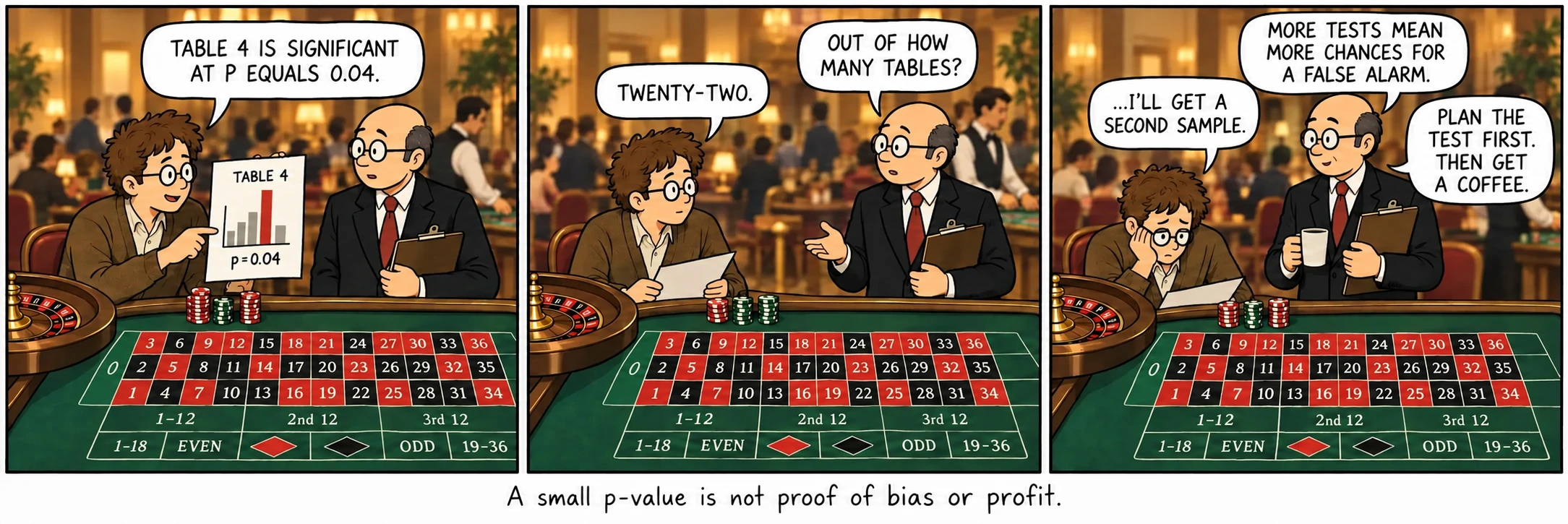
Vhiri rimwe chete pamavhiri makumi maviri akarurama “rine kukosha”. Ndizvo zvinorehwa nenhamba iyi.
Zvinyorwa
- Pearson, K. “On the criterion that a given system of deviations from the probable…”
- Feller, W. An Introduction to Probability Theory and Its Applications, Vol. 1.