Standard Deviation muRoulette
Standard deviation muRoulette, square root yemusiyanomasvomhuMusiyanoChiyero chekuti mhedzisiro yakapararira zvakadii kutenderedza kukosha kunotarisirwa. Wakakwirira pastraight up, wakaderera pamabheti emubhadharo wakaenzana.Verengai zvese →, ndiro daro rakajairika pakati pemhedzisiro nezvainotarisirwa.

Per $1 staked, σ is 5.84 for a straight upbhetiStraight upNhamba imwe chete, rinobhadhara 35:1.Verengai zvese → and 1.00 for red. For independent spinsmasvomhuKutenderera kwakazvimiriraKutenderera kwega kwega kune mikana imwe chete zvisinei nezvakaitika kare. Ihwo hwaro hwekuverenga kwese pawebhusaiti ino.Verengai zvese → with the same bet and stake, multiply by the stake and the square root of the number of spins.
Mutemo wenyore
When a normal approximation is suitable, about 68% of results lie within one standard deviationmasvomhuStandard deviationMudzi wesikweya wemusiyano; chinhambwe chakajairwa chemhedzisiro kubva pakukosha kunotarisirwa.Verengai zvese → of the mean and 95% within two. These are approximations, not universal rules. For 100 independent $10 bets on redbhetiTsvukuBheti remubhadharo wakaenzana panhamba 18 tsvuku. ChiFrench: rouge.Verengai zvese →, the expected result is about −$27 and the standard deviation is $100. The exact binomial probabilities below account for the fact that final results come in $20 steps. An unusual session alone does not establish an advantage.
Sei √N
Expected lossmasvomhuKurasikirwa kunotarisirwaKukosha kunotarisirwa kwakapetwa nemari yose yakabhejwa; mari yepakati inorasika musesheni kana munguva yakati.Verengai zvese → grows in proportion to N; spread grows in proportion to √N. For short sessions, random variation can be large compared with the expected loss. As N grows, expected loss becomes larger relative to that spread. The crossover, where expected loss equals one standard deviation, is at N = (σ/edge)². Using unrounded single-zerovhiriZeroGomba rimwe chete rakasvibira risingafukidzwi nebheti remubhadharo wakaenzana, redozeni kana rekoramu; ndiko kunobva chikamu chekasino. Mamwe mazita: zero imwe, 0.Verengai zvese → values gives 1,368 spins for even-money betsbhetiBheti remubhadharo wakaenzanaTsvuku/nhema, isina kuenzana/yakaenzana, dzepamusoro/dzepasi. Nhamba 18, rinobhadhara 1:1.Verengai zvese → and 46,656 for straight-up bets. This is a comparison of scales, not a point at which outcomes become certain.
Kuishandisa
To judge whether a session was unusual, compute (result − EV)/σ. A $10 red bettor who finishes 100 spins at +$160 has won 58 spins and lost 42. That result is about (160 + 27)/100 = 1.87 standard deviations above the mean. The exact probabilitymasvomhuMukanaMukana wemhedzisiro, kubva pa0 kusvika pa1 kana 0% kusvika 100%. Nhamba imwe: 1/37 = 2.70%.Verengai zvese → of finishing at +$160 or better is about 3.82%. The z-score describes distance from the mean; use the actual outcome distribution to calculate a tail probability.
Standard error yechikamu
Arithmetic imwe chete iyi inokuudzai kuti kunoda kutenderera kwakawanda sei kuti muone chikamu chekasino mudata. Standard error yechikamu chekukunda chinoonekwa i√(p(1 − p)/N). Patsvuku neN = 1,000: √(0.4865 × 0.5135 / 1000) ≈ 1.6%. Musiyano pakati pemari yakarurama inokandwa netsvuku i1.35%, saka mushure mekutenderera 1,000 hamusati mavakugona kuzvisiyanisa nechivimbo. Mushure me10,000 standard error i0.5% uye munogona. Ndosaka kuona kutsauka kwevhiri kuchidawo kutenderera kwakawanda kudaro.
Chenjedzo pamusoro pekutsauka (skew)
Straight-up results are far from normally distributed in a short session: most sessions are a steady −$10 per spin with occasional +$350 jumps. The standard deviation remains valid, but the normal 68%/95% rule can be misleading. For even-money bets, the normal approximation becomes more useful as the number of spins grows; an exact binomial calculation avoids approximation error.
Fomula
Mibvunzo
Humbowo hwekuti makatamba masesheni anenge 40, kana kuti makanga muri muiya imwe ine rombo pamakumi mana. Zviitei zvakare.
For independent spins with a fixed bet and stake, the standard error of the average is σ/√N. At 10,000 spins it is about 1% of the stake for red, but about 5.84% for a straight-up bet. The spread shrinks with N; the observed average need not move steadily toward its expectation.
Kutamba neMasvomhu
Edzai izvi imi pachenyu pekutanga. Mhinduro yega yega yakapetwa; ivhurei kana magadzirira.
Pakutenderera 100 kwevhiri reEurope, yunitimariYunitiMari yehwaro inoshandiswa nesisitimu kana nemutambi. Maprogression anotsanangurwa nemayuniti kuitira kuti ashande patafura ipi zvayo.Verengai zvese → imwe patsvukubhetiTsvukuBheti remubhadharo wakaenzana panhamba 18 tsvuku. ChiFrench: rouge.Verengai zvese → iri mberi nekukunda kunenge 51, uye yuniti imwe pastraight upbhetiStraight upNhamba imwe chete, rinobhadhara 35:1.Verengai zvese → iri mberi kana nhamba yayo ikabuda kanenge ka3. Shandisai bell curve kufungidzira mikana yose miviri, mozoienzanisa nemhinduro chaidzo.
Ratidza mhinduro
Mhinduro Tsvuku: bell curve inopa 35.6% uye mhinduro chaiyo i35.5%. Straight up: bell curve inopa 55.0% uye mhinduro chaiyo i50.9%. Nzira pfupi inoshanda patsvuku uye inopotsa panhamba imwe.
Tsvuku: kukunda kune avhareji ye100 × 18/37 = 48.6, nekupararira kwe√(100 × 18/37 × 19/37) = 5.0. Kuva mberi kunoreva 51 kana kupfuura; pakati, 50.5, pari kupararira 0.37 pamusoro peavhareji, uye bell curve inoisa 35.6% pamusoro paipapo. Kuwedzera mikana chaiyo yekukunda 51, 52 … 100 kunopa 35.5%.
Straight up: kubuda kune avhareji ye100/37 = 2.70, nekupararira kwe√(100 × 1/37 × 36/37) = 1.62. Kubuda katatu kana kupfuura kunoreva pamusoro pe2.5, kupararira 0.12 pasi peavhareji: 55.0% nebell curve. Chaizvo, i1 kubvisa mikana yekubuda 0, 1 ne2, 6.5% + 17.9% + 24.7%, izvo zvinosiya 50.9%.
Bell curve inoda mhedzisiro yakawanda kumativi ose eavhareji. Tsvuku inayo mushure mekutenderera 100; nhamba inobuda kasingasviki katatu paavhareji haina. Curve inotopa 8.7% ku“kusabuda”, apo mukana chaiwo uri 6.5%. Taylor (2021) anoisa binomial nebell curve padivi nepadivi nenzira imwe chete iyi.
Kuseka zvishoma
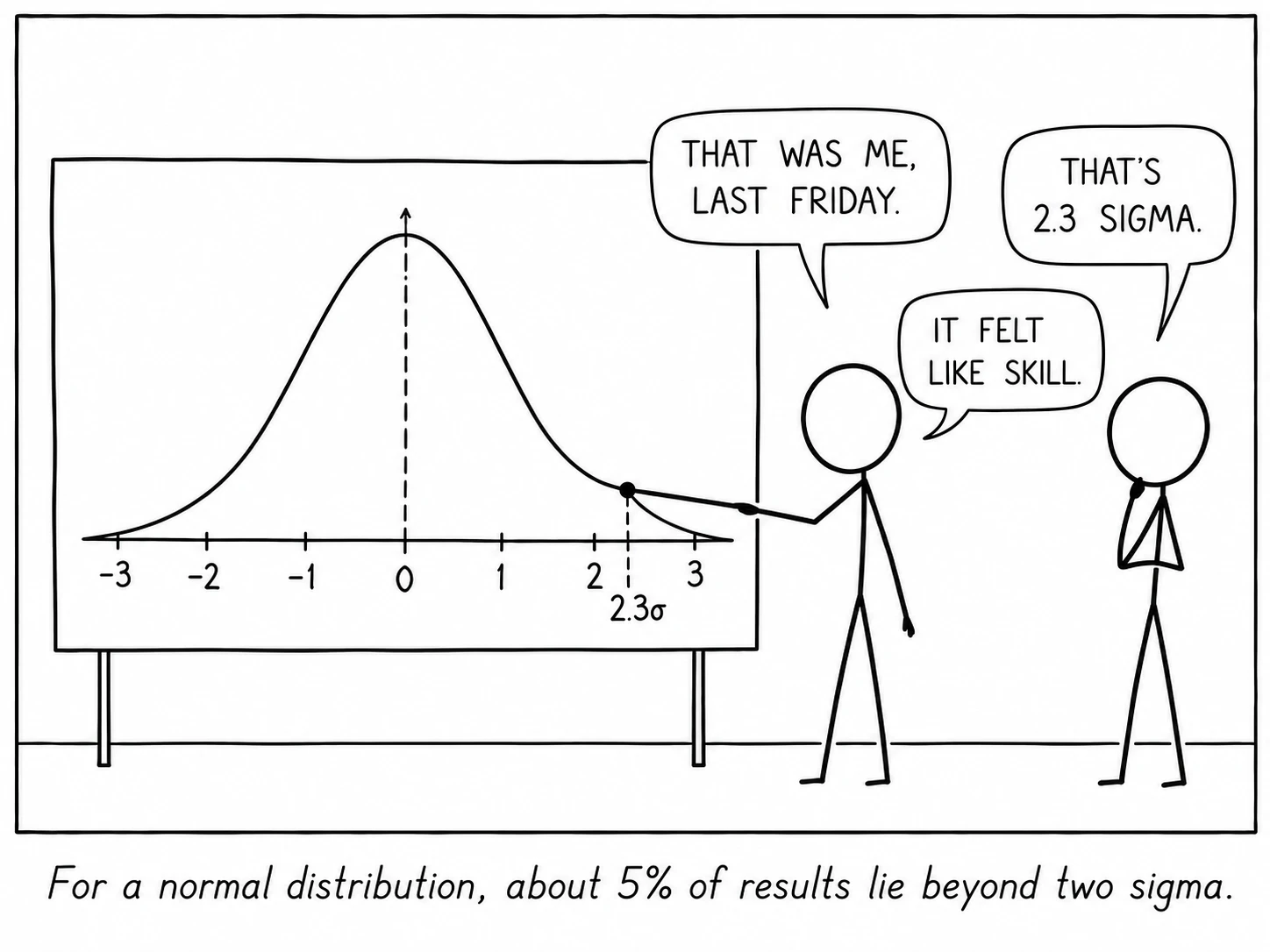
Under a normal approximation, about 5% of results lie more than two standard deviations from the mean.
Zvinyorwa
- Feller, W. An Introduction to Probability Theory and Its Applications, Vol. 1.
- Ethier, S. N. The Doctrine of Chances: Probabilistic Aspects of Gambling.
- Taylor, D. G. Games, Gambling, and Probability: An Introduction to Mathematics, 2nd ed.