Kelly Criterion neRoulette
Kelly criterion inoudza mubheji ane mukana wakanaka kuti angabheja zvakadii. MuRoulette inopa mhinduro yakajeka: hapana.

Mari yeKelly = mukana wakanaka / mikana. Kana mukana wakaipa fomula inodzosa chikamu chakaipa, zvinoreva kuti musabheja. Criterion iyi ichiri kubatsira kunzwisisa kuti sei vatambi vekutsauka kwevhiri vaiyera mabheti avo nenzira yavaiita, uye sei vamwe vese vanofanira kuyera nebhajeti.
Criterion
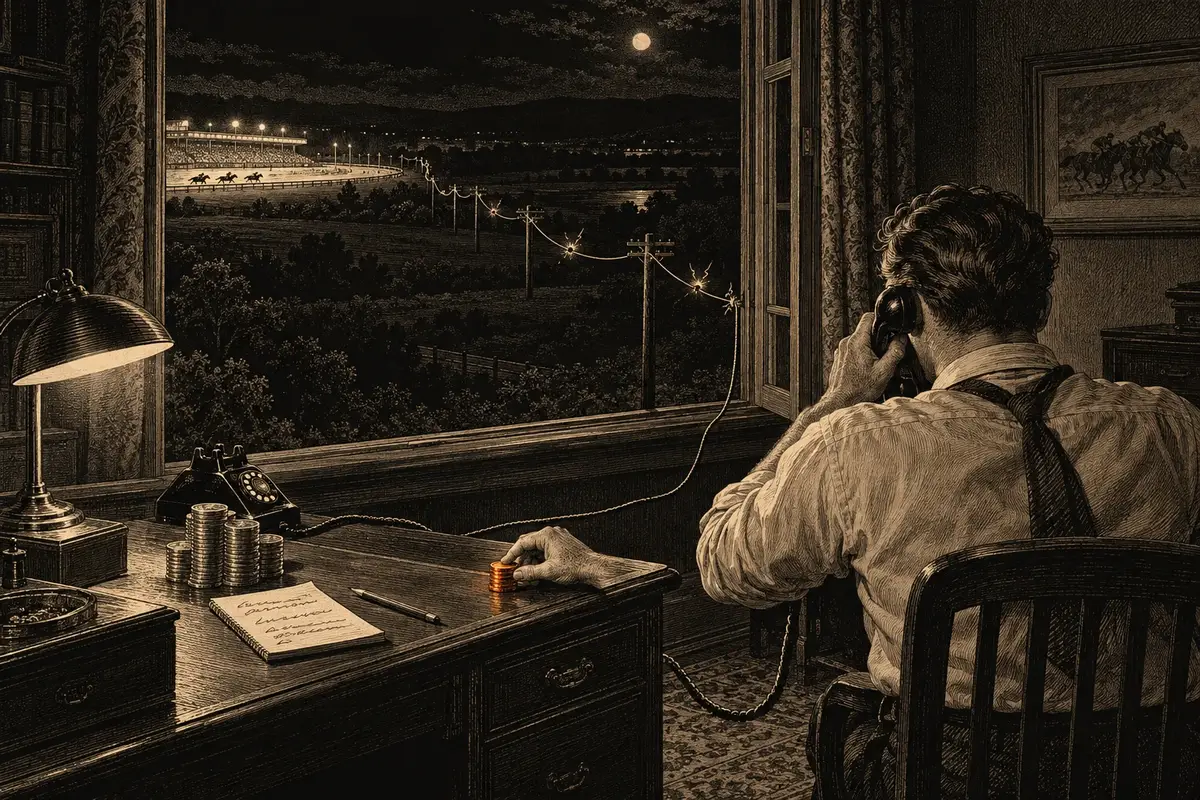
John Kelly (1956) asked how a gambler with a known edge should size bets to maximize long-run growth of the bankrollmariMari yekutambaMari yose yakachengeterwa kutamba. Kutonga mari yekutamba kuri kusarudza kuti mungaisa pangozi yakawanda sei pabheti rimwe nepasesheni imwe.Verengai zvese →. The answer, for a bet paying b to 1 with win probabilitymasvomhuMukanaMukana wemhedzisiro, kubva pa0 kusvika pa1 kana 0% kusvika 100%. Nhamba imwe: 1/37 = 2.70%.Verengai zvese → p and loss probability q = 1 − p, is to stake the fraction f* = (bp − q) / b of the bankroll. Positive f* means bet that fraction; zero or negative means do not bet. Kelly worked at Bell Labs, and his paper, “A new interpretation of information rate”, set the problem in Claude Shannon’s theory of information: a gambler who gets tips over a noisy line, at fair odds, can grow the bankroll at best at the rate the line carries information. This is a growth objective under a probability model, not a promise to finish ahead after a particular number of bets. A spending limit, finite deadline or payoutmariMubhadharoZvinodzoserwa nebheti rakunda, zvinotaurwa se“X kusvika ku1” pamusoro pemari yakabhejwa inodzoserwa.Verengai zvese → cap changes the decision problem.
Kubheja kweKelly muRoulette
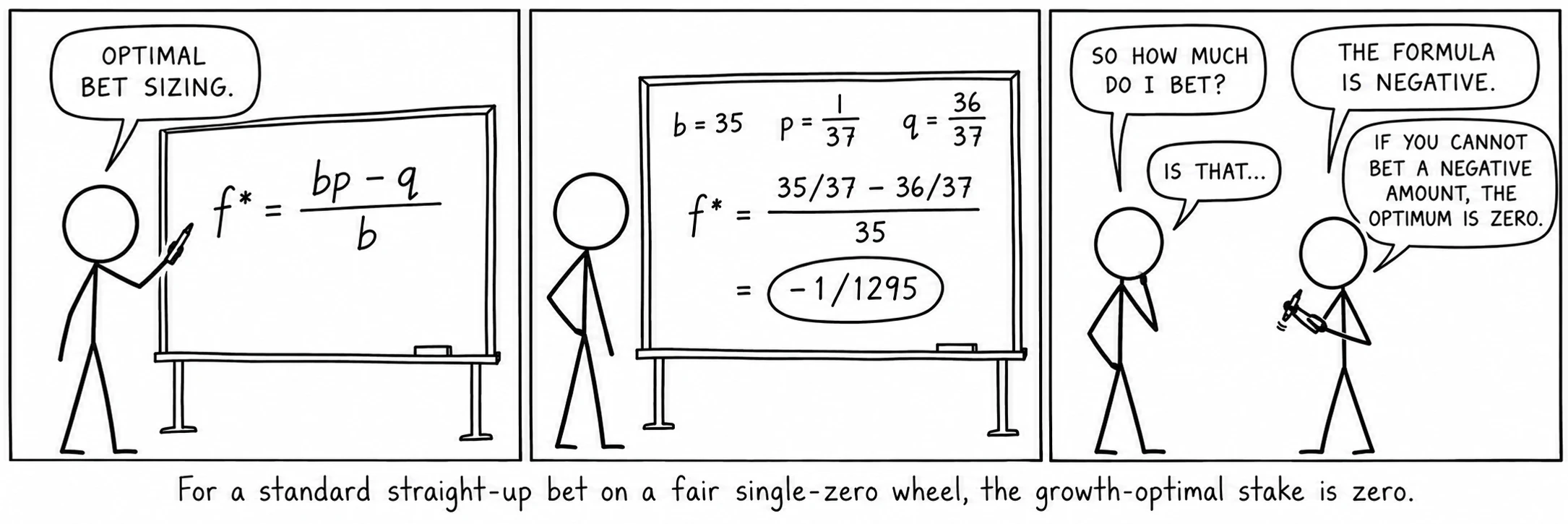
For redbhetiTsvukuBheti remubhadharo wakaenzana panhamba 18 tsvuku. ChiFrench: rouge.Verengai zvese →: b = 1, p = 18/37, q = 19/37; f* = (18/37 − 19/37)/1 = −1/37. For a straight upbhetiStraight upNhamba imwe chete, rinobhadhara 35:1.Verengai zvese →: b = 35, p = 1/37, q = 36/37; f* = (35/37 − 36/37)/35 = −1/1295. Every standard bet gives a negative Kelly fraction, because every bet has a negative edge, and the growth-optimal stake is zero. Kelly betting on roulette is a formal way of saying what the house-edge page says: no positive stake maximizes expected logarithmic growth when the bet has negative expectation. A particular session can still end in profit. La partagemutemoLa partageMutemo wechiFrench: kana zero yabuda, hafu yemari yakabhejwa pabheti remubhadharo wakaenzana inodzoserwa. Inoita hafu chikamu chekasino pamabheti iwayo kusvika pa1.35%.Verengai zvese → needs a separate three-outcome calculation: a win, a full loss or a half-loss on zerovhiriZeroGomba rimwe chete rakasvibira risingafukidzwi nebheti remubhadharo wakaenzana, redozeni kana rekoramu; ndiko kunobva chikamu chekasino. Mamwe mazita: zero imwe, 0.Verengai zvese →. Its expected log growth also falls as the stake increases from zero.
Apo Kelly yakashanda
Suppose a pocketmidziyoGombaImwe yemakamuri 37 ane nhamba parotor. Mamwe mazita: slot, cup.Verengai zvese → really has a stable, known probability of 1 in 30 and pays 35 to 1. The Kelly fraction is 0.57%: about $57 from a $10,000 bankroll. Under independent spinsmasvomhuKutenderera kwakazvimiriraKutenderera kwega kwega kune mikana imwe chete zvisinei nezvakaitika kare. Ihwo hwaro hwekuverenga kwese pawebhusaiti ino.Verengai zvese → and exact fractional staking, the geometric growth factor over 1,000 spins is about 1.7. Expected bankroll grows faster because rare large wins pull up the average. These are model calculations, not evidence that any named historical player used Kelly or achieved this result.
Yakajairika neyepaavhareji
The gap between the typical bankroll and the average one is wide. Take a pocket that hits 1 time in 25, a hypothetical edge of 44% per unitmariYunitiMari yehwaro inoshandiswa nesisitimu kana nemutambi. Maprogression anotsanangurwa nemayuniti kuitira kuti ashande patafura ipi zvayo.Verengai zvese → staked. Kelly stakes 1.26% of the bankroll on it. After 1,000 spins the typical bankroll has grown about 11.5 times, while the average, pulled up by a few very lucky runs, has grown about 249 times. Betting more than Kelly raises the average and lowers the typical result: at twice the Kelly stake the typical bankroll only doubles, and by two and a half times the Kelly stake it shrinks, although every bet still carries a 44% edge. In this example, half-Kelly retains about 78% of the expected log growth. This fraction depends on the probabilities and payout.
Kana mukana wakanaka uri fungidziro
Kelly uses the true probabilities, but a player usually has only estimates. Selecting the busiest pocket from a past record creates a selection problem: even a fair wheel has a busiest pocket. Its observed rate can overstate its future probability. Choosing the stake from that same record compounds the error. An independent follow-up sample helps test a proposed bias (see How to Detect Roulette Wheel Bias). Reducing the calculated fraction reduces exposure, but cannot turn a false edge into a real one.
Vanhu vane mukana wakanaka
Haghani and Dewey (2016) studied 61 participants given $25 and 30 minutes to bet on a simulated coin with a disclosed 60% chance of heads. The payout cap was $250; its value was revealed when a proposed winning bet would reach it. Their reported 21% success category included balances of at least $200, while the 28% “bust” category meant less than $2, not necessarily zero. Eighteen participants bet their entire balance on one flip. The uncapped Kelly fraction is 20%, but the cap and deadline change the optimization problem. The experiment illustrates how stake choices matter even with a known advantage; it does not establish one best strategy for every objective.
Zvekushandisa pachinzvimbo
Pasina mukana wakanaka, kuyera mubvunzo webhajeti, kwete wekukura: mari yakabhejwa = zvamunoda kushandisa pakutenderera, zvichibva pabhajeti yeawa nekumhanya kwetafura (peji rekutonga mari yekutamba). Chipo chaKelly kumutambi akajairika kujeka kwemhinduro yayo: zero. Zvese zvamunobheja pamusoro pezero mutengo wekutamba, wakasarudzwa nemi, kwete wakagadziriswa nefomula ipi neipi.
Chinyorwa pamusoro pefractional Kelly ne“kutonga mari”
Betting a fixed percentage of the current bankroll is proportional staking: the stake rises after wins and falls after losses. Flat bettingnziraKubheja kwakaenzanaKubheja mari imwe chete pakutenderera kwega kwega. Chiyero chinoenzaniswa nacho progression yega yega.Verengai zvese → instead keeps the cash stake fixed. Neither creates an edge on ordinary roulette. With infinitely divisible stakes and a fraction below 100%, proportional staking never reaches exactly zero in finitely many losses, but the balance can become arbitrarily small. Real table minimums can prevent further play much sooner. The growth-optimal fraction remains zero.
Fomula
Mibvunzo
Only when the actual probabilities, payouts and conditions give a credible positive advantage. Standard bets on an unbiased wheel have no such advantage.
Using half the calculated fraction reduces exposure to errors in the estimated edge. The familiar three-quarters-growth rule is an approximation for small advantages, not a universal identity. It does not protect against an edge that does not exist.
Kwete. Kelly inogadzirisa kukura kana paine mukana wakanaka. Kutonga mari yekutamba kunodzora kushandisa kana pasina.
Kutamba neMasvomhu
Edzai izvi imi pachenyu pekutanga. Mhinduro yega yega yakapetwa; ivhurei kana magadzirira.
Suppose a hypothetical bet on one number has a known 44% edge under standard payoutsmariMubhadharoZvinodzoserwa nebheti rakunda, zvinotaurwa se“X kusvika ku1” pamusoro pemari yakabhejwa inodzoserwa.Verengai zvese → and independent spinsmasvomhuKutenderera kwakazvimiriraKutenderera kwega kwega kune mikana imwe chete zvisinei nezvakaitika kare. Ihwo hwaro hwekuverenga kwese pawebhusaiti ino.Verengai zvese →. Kelly gives a 1.26% bankrollmariMari yekutambaMari yose yakachengeterwa kutamba. Kutonga mari yekutamba kuri kusarudza kuti mungaisa pangozi yakawanda sei pabheti rimwe nepasesheni imwe.Verengai zvese → fraction. What if the same 44% edge came on one bet spread over five neighboring numbers?
Ratidza mhinduro
Mhinduro Ipapo Kelly anoti 7.1% yemari yekutamba, uye mari yekutamba inokura kanenge katanhatu nekukurumidza: anenge 1.25 miriyoni pamabheti 1,000, kana zvichienzaniswa nekanenge ka11.5.
A straight upbhetiStraight upNhamba imwe chete, rinobhadhara 35:1.Verengai zvese → with a 44% edge wins with chance 0.04, since 36 × 0.04 = 1.44. Kelly’s stake is the edge divided by the odds: 0.44/35 = 1.26%. The typical growth per bet is 0.04 × ln(1 + 35 × 0.0126) + 0.96 × ln(1 − 0.0126) ≈ 0.00244, so 1,000 bets multiply the bankroll by about e^2.44 ≈ 11.5.
Spread one stake over five numbers and the bet wins with chance 0.20 and pays 36/5 for 1, that is 6.2 to 1: still a 44% edge, since 0.2 × 7.2 = 1.44. Kelly’s stake becomes 0.44/6.2 = 7.10%, and the growth per bet 0.01404, about 5.75 times as much. Over 1,000 bets that is e^14.04, about 1.25 million.
The edge is the same; the swings are smaller. A bet that wins one time in five has a larger growth-optimal fraction in this model, although losses can still reduce the bankroll severely. This comparison assumes the same known edge for both bets; actual predictions need independent evidence.
Assume two numbers are adjacent on the betting layoutmidziyoTafura yekubhejeraGridhi yekubhejera yakadhindwa patafura. Mamwe mazita: table, felt, cloth.Verengai zvese → and each has a stable, known probabilitymasvomhuMukanaMukana wemhedzisiro, kubva pa0 kusvika pa1 kana 0% kusvika 100%. Nhamba imwe: 1/37 = 2.70%.Verengai zvese → of 1 in 25 on independent spins. Compare a splitbhetiSplitNhamba mbiri dzakavakidzana, rinobhadhara 17:1.Verengai zvese → between them at 17 to 1 with equal straight-up stakes on the two numbers. How much does Kelly say, and how fast does the bankroll grow compared with one such pocketmidziyoGombaImwe yemakamuri 37 ane nhamba parotor. Mamwe mazita: slot, cup.Verengai zvese →?
Ratidza mhinduro
Mhinduro Hazvina musiyano: 2.59% yemari yekutamba pasplit, kana 1.29% panhamba imwe neimwe. Mari yekutamba yakajairwa inokura kanenge ka155 pakutenderera 1,000, kana zvichienzaniswa neka11.5 negomba rimwe.
The split wins with probability 2/25 = 0.08 and pays 17 to 1, so it returns 18 × 0.08 = 1.44 per unitmariYunitiMari yehwaro inoshandiswa nesisitimu kana nemutambi. Maprogression anotsanangurwa nemayuniti kuitira kuti ashande patafura ipi zvayo.Verengai zvese → staked: an edge of 44%, the same as one biased pocket. Kelly’s stake is the edge divided by the odds: 0.44/17 = 2.59%.
Two straight-up bets of 1.29% each give exactly the same results. When either number comes up, one chipmariChipiChiratidzo chinomiririra mari yakatarwa, chinoiswa patafura yekubhejera kuita bheti. Rimwe zita: check.Verengai zvese → wins 35 to 1 and the other is lost, a net of 34 × 1.29% = 44% of the bankroll, as the split pays; when neither does, both are lost.
The growth per spin is 0.00505, against 0.00244 for one pocket, so over 1,000 spins the typical bankroll grows e^5.046 ≈ 155 times rather than e^2.44 ≈ 11.5 times. The geometric growth factor is larger because the combined bet wins more often at the same 44% edge. It is a model result, not a guaranteed bankroll.
Kuseka zvishoma
Mari yeRoulette inokurisa zvakanyanya inhamba inotozivikanwa nemunhu wese.
Zvinyorwa
- Kelly, J. L. “A new interpretation of information rate.”
- Breiman, L. “Optimal gambling systems for favorable games.”
- Thorp, E. O. “Optimal gambling systems for favorable games.”
- Thorp, E. O. The Mathematics of Gambling.
- Epstein, R. A. The Theory of Gambling and Statistical Logic, 2nd ed.
- Taylor, D. G. Games, Gambling, and Probability: An Introduction to Mathematics, 2nd ed.
- Ethier, S. N. The Doctrine of Chances: Probabilistic Aspects of Gambling.
- Haghani, V. & Dewey, R. “Rational decision-making under uncertainty: observed betting patterns on a biased coin.”