Dambudziko: Muganho weTafura
Martingale ye$10 patafura ye$500. Inoputsika kangani, inorasikirwa zvakadii kana yaputsika, uye kukwidza muganho kunobatsira here?
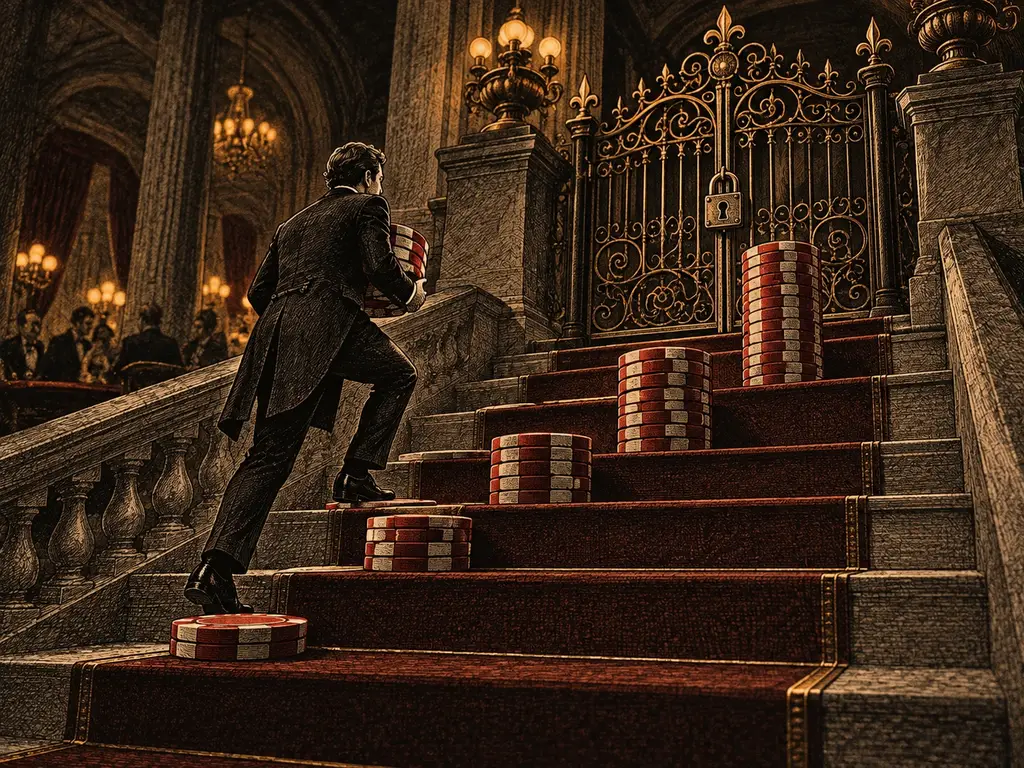
Kurasikirwa katanhatu kwakatevedzana kunoiputsa: 1.8% pakutenderera kwedenderedzwa rimwe, anenge 60% yemasesheni ekutenderera 100. Kuputsika kunodhura $630. Kukwidza muganho kusvika $5,000 kunoita kuti kuputsika kusawanzoitika (0.25% padenderedzwa) asi kuve kukuru ($5,110). Kurasikirwa kunotarisirwa padhora rakabhejwa i2.70% pamuganho upi neupi.
Dambudziko
Assume independent spinsmasvomhuKutenderera kwakazvimiriraKutenderera kwega kwega kune mikana imwe chete zvisinei nezvakaitika kare. Ihwo hwaro hwekuverenga kwese pawebhusaiti ino.Verengai zvese → and standard single-zerovhiriZeroGomba rimwe chete rakasvibira risingafukidzwi nebheti remubhadharo wakaenzana, redozeni kana rekoramu; ndiko kunobva chikamu chekasino. Mamwe mazita: zero imwe, 0.Verengai zvese → payoutsmariMubhadharoZvinodzoserwa nebheti rakunda, zvinotaurwa se“X kusvika ku1” pamusoro pemari yakabhejwa inodzoserwa.Verengai zvese →, with enough bankrollmariMari yekutambaMari yose yakachengeterwa kutamba. Kutonga mari yekutamba kuri kusarudza kuti mungaisa pangozi yakawanda sei pabheti rimwe nepasesheni imwe.Verengai zvese → to fund each permitted stake. A player bets $10 on redbhetiTsvukuBheti remubhadharo wakaenzana panhamba 18 tsvuku. ChiFrench: rouge.Verengai zvese → and doubles after each loss, resetting after a win. The table maximum is $500. (a) How many consecutive losses break the progressionnziraProgressionMutemo upi zvawo unochinja mari yekubheja zvichienderana nemhedzisiro yakapfuura. Maprogression anokwira mushure mekurasikirwa anoikwidza kana mukarasikirwa; maprogression anokwira mushure mekukunda anoikwidza kana mukakunda.Verengai zvese →? (b) What is the probabilitymasvomhuMukanaMukana wemhedzisiro, kubva pa0 kusvika pa1 kana 0% kusvika 100%. Nhamba imwe: 1/37 = 2.70%.Verengai zvese → per cycle? (c) What is lost at the break? (d) How does a $5,000 limit change the answers? (e) Does any limit make the system profitable?
Mhinduro (a)–(c)
Mari dzakabhejwa: 10, 20, 40, 80, 160, 320. Yechinomwe yaizova 640 > 500, saka kurasikirwa katanhatu kunoiputsa. (b) p(kurasikirwa) = 19/37 patsvuku; (19/37)⁶ = 0.0183, anenge 1.8% padenderedzwa. Denderedzwa rinogara kutenderera kunenge kuviri paavhareji, saka sesheni yekutenderera 100 ine madenderedzwa anenge 50 uye p(kuputsika kamwe chete zvishoma) ≈ 1 − 0.9817⁵⁰ ≈ 60%. (c) 10 + 20 + 40 + 80 + 160 + 320 = $630, iri mayunitimariYunitiMari yehwaro inoshandiswa nesisitimu kana nemutambi. Maprogression anotsanangurwa nemayuniti kuitira kuti ashande patafura ipi zvayo.Verengai zvese → ekutanga 63, pane $10 yaiedzwa kukundwa nedenderedzwa.
Mhinduro (d)
At $5,000: stakes to 2,560 are allowed; the tenth stake, 5,120, is refused. Nine losses break it: (19/37)⁹ ≈ 0.25% per cycle, about 11% of 100-spin sessions. Loss at the break: 10 + 20 + … + 2,560 = $5,110. The player has bought a rarer catastrophe at the price of a larger one. Over many sessions the expected cost of breaks is p × loss ≈ 0.0183 × 630 = $11.5 per cycle at the $500 limit and 0.0025 × 5,110 = $12.8 at $5,000; each is the expected contribution from failed cycles. Subtract the expected profit from successful cycles, $10 × (1 − p), to obtain total expected lossmasvomhuKurasikirwa kunotarisirwaKukosha kunotarisirwa kwakapetwa nemari yose yakabhejwa; mari yepakati inorasika musesheni kana munguva yakati.Verengai zvese → per cycle: about $1.74 and $2.71 respectively.
Mhinduro (e)
With a finite limit and a well-defined stopping rule, expected loss equals expected turnovermariMari yose yakabhejwaMari yese yakabhejwa musesheni kana munguva yakati, kusanganisira mari yakakundwa yakabhejwazve. Mamwe mazita: handle, action.Verengai zvese → divided by 37. Changing the limit can change turnover substantially. For the 100-spin examples below, the player resets to $10 after either a win or a failed progression, and has enough money to place every bet. These are exact model expectations, not a simulation. The imaginary unlimited-bankroll, unlimited-stake MartingalenziraMartingaleProgression inopeta bheti kaviri mushure mekurasikirwa kwega kwega. Onai chikamu cheNzira kuti munzwisise zvainoita nezvaisingaite.Verengai zvese → is different: a single cycle eventually wins $10 with probability 1, but its expected turnover is infinite. The finite-expectation identity cannot be applied to that unbounded stopping problem. Real bankrolls and tables cannot implement it.
Matafura maviri chaiwo
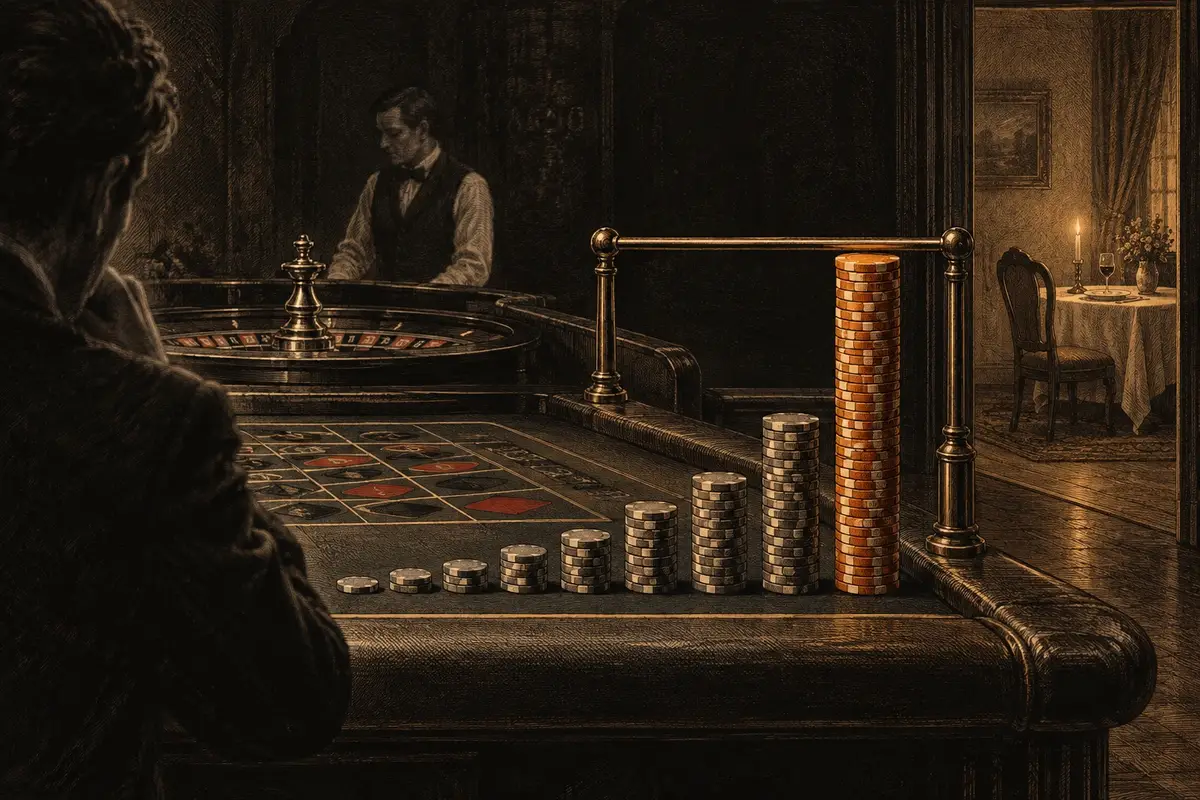
Muenzaniso waThorp itafura ye$1 ine $1,000 yepamusoro-soro, apo mutambi anovimba kukunda $30 yekudya kwemanheru dhora rimwe panguva. Mari 1, 2, 4 … 512 dzinobvumira mabheti gumi, saka kurasikirwa kagumi kwakatevedzana kunoputsa progression: kamwe pamadenderedzwa 785 pavhiri reEurope (kamwe pa613 pavhiri reAmerica), pamutengo we$1,023. Madenderedzwa makumi matatu anobudirira ese 96.2% yenguva. Imwe 3.8% inorasikirwa anenge $1,000, uye mhedzisiro yepaavhareji yemanheru iri −$9.17, iri chaizvo 1/37 ye$339 inobhejwa nemadenderedzwa makumi matatu paavhareji. Tafura ye$5 ine $2,000 yepamusoro-soro haina kusiyana: mari kusvika $1,280 dzinobvumira mabheti mapfumbamwe, uye kuputsika kunouya kamwe pamadenderedzwa 403 pavhiri reEurope (kamwe pa323 pavhiri reAmerica) uye kunodhura $2,555.
Mutambi akapfuma
The table maximum is only one constraint. The player may run out of money before reaching it. A simulation must state whether it stops, resets to the base stake or bets the remaining balance when the next double is unaffordable. Those choices change session probabilities, so results from one rule cannot describe every Martingale strategy.
Chidzidzo
A higher limit permits rarer but larger failed progressions. It does not remove the negative expectation of each standard bet, and it may increase the amount wagered. Compare the total exposure and stopping rule as well as the chance of a short winning cycle.
Fomula
Mibvunzo
Inokubvumirai kupona kusvika pamuganho wakakwira, apo kuputsika kusingawanzoitiki asi kuri kukuru. Kurasikirwa kunotarisirwa padhora hakuchinji.
Mari 10, 30, 70, 150, 310: muganho we$500 unosvikwa mushure mekurasikirwa kashanu, uye kuputsika kunodhura $570. 2.70% imwe chete.
A maximum limits the payout exposure accepted on a bet. The operator sets the actual limits; their existence does not create roulette’s house edgemasvomhuChikamu chekasinoChikamu chemari yega yega yakabhejwa chinochengetwa nekasino paavhareji: 2.70% muRoulette yeEurope.Verengai zvese →.
Kutamba neMasvomhu
Edzai izvi imi pachenyu pekutanga. Mhinduro yega yega yakapetwa; ivhurei kana magadzirira.
A MartingalenziraMartingaleProgression inopeta bheti kaviri mushure mekurasikirwa kwega kwega. Onai chikamu cheNzira kuti munzwisise zvainoita nezvaisingaite.Verengai zvese → starts at $100 on redbhetiTsvukuBheti remubhadharo wakaenzana panhamba 18 tsvuku. ChiFrench: rouge.Verengai zvese → and allows itself at most n bets a cycle: after n losses in a row it gives up and starts again. Write the average result of one cycle as a formula in n, and work it out for 5, 6 and 7 bets on a European wheel. Assume independent uniform single-zerovhiriZeroGomba rimwe chete rakasvibira risingafukidzwi nebheti remubhadharo wakaenzana, redozeni kana rekoramu; ndiko kunobva chikamu chekasino. Mamwe mazita: zero imwe, 0.Verengai zvese → results and sufficient funds for every permitted stake.
Ratidza mhinduro
Mhinduro Avhareji i100 × (1 − (38/37)ⁿ): −$14.26 pamabheti 5, −$17.35 pa6 uye −$20.52 pa7. Kubvumira mabheti akawanda kunoita kuti denderedzwa repaavhareji riwedzere kuipa, kwete kunaka.
A cycle wins $100 unless all n bets lose, which happens with chance qⁿ, where q = 19/37. When they all lose, the stakes 100, 200 … 100 × 2ⁿ⁻¹ add up to 100 × (2ⁿ − 1). So the average is 100 × (1 − qⁿ) − 100 × (2ⁿ − 1) × qⁿ = 100 × (1 − (2q)ⁿ).
Here 2q = 38/37, a little more than 1, so (2q)ⁿ grows with n and the average falls: n = 5 gives 1.1426 and −$14.26; n = 6 gives 1.1735 and −$17.35; n = 7 gives 1.2052 and −$20.52. A longer ladder loses less often, in 3.6%, 1.8% and 0.9% of cycles, but each loss is twice as large, and more money crosses the table each cycle, at 2.70% of every bet.
On an American wheel 2q = 40/38 and the figures are −$29.24, −$36.04 and −$43.20. In a game with no zero 2q = 1, and every cycle averages exactly zero however long the ladder.
“Grand Martingale” inopeta kaviri mari yekubheja mushure mekurasikirwa uye yowedzera yunitimariYunitiMari yehwaro inoshandiswa nesisitimu kana nemutambi. Maprogression anotsanangurwa nemayuniti kuitira kuti ashande patafura ipi zvayo.Verengai zvese → imwe, saka mari dzekubheja dzinofamba 1, 3, 7, 15, 31 … Muri pamusoro nemarii kana kukunda kwekutanga kukauya pabheti re1, re2, re3 kana re k? Neyuniti ye$10 nemuganho wepamusoro we$500, denderedzwa rinoputsika kangani, uye denderedzwa rinodhura marii paavhareji?
Ratidza mhinduro
Mhinduro Kukunda pabheti re k kunokusiyai muri pamusoro nemayuniti k: +1, +2, +3 zvichidaro. Pa$10 ne$500 denderedzwa rinoputsika mushure mekurasikirwa kushanu, 3.57% yemadenderedzwa, zvichiita −$570. Paavhareji denderedzwa rinorasikirwa $2.32 pa$85.73 yakabhejwa: 2.70%.
The kth stake is 2ᵏ − 1 units: 1, 3, 7, 15, 31. The first k − 1 stakes add up to 2ᵏ − 2 − (k − 1) = 2ᵏ − k − 1. A win on the kth bet pays 2ᵏ − 1, so the cycle ends (2ᵏ − 1) − (2ᵏ − k − 1) = k units up: one extra unit for every loss before the win.
At least $570 is needed to fund all five stakes in a fresh cycle. At $10 a unit the stakes are $10, $30, $70, $150 and $310; the next, $630, is over the $500 maximum. Five losses in a row, (19/37)⁵ = 3.57%, cost 10 + 30 + 70 + 150 + 310 = $570.
Average: the wins bring in $10 × k with chance (19/37)ᵏ⁻¹ × 18/37 for k = 1 to 5, and the break takes $570 with chance 3.57%; together −$2.32. The money staked averages $85.73 a cycle, and 2.32/85.73 = 2.70%. The ordinary Martingale at the same table breaks after six losses, 1.83% of cycles, for −$630, and loses $1.74 out of $64.20 staked: 2.70% again.
Mutambi anoronga Martingale patsvuku nebheti rekutanga re$1 patafura ine muganho we$1,000, saka mabheti gumi anogoneka: $1, $2, $4 zvichidaro kusvika $512. Denderedzwa rinorasikirwa ose gumi kangani, izvozvo zvinotora nguva yakareba sei paavhareji, uye manheru emabheti 200 anopera saizvozvo kangani?
Ratidza mhinduro
Mhinduro Denderedzwa rinorasikirwa ose gumi kamwe chete pa784, izvo zvinodhura $1,023. Ndiwo mabheti anenge 1,600 paavhareji, uye manheru emabheti 200 anorova madziro anenge 11% yenguva. Denderedzwa richiri kurasikirwa $0.31 paavhareji pa$11.31 yakabhejwa: 2.70%.
Bheti patsvuku rinorasikirwa nemukana we19/37, zero ichisanganisirwa. Gumi akateverana: (19/37)¹⁰ ≈ 0.00128, anenge 1 pa784. Mari dzakabhejwa 1 + 2 + 4 + … + 512 dzinosvika $1,023.
Denderedzwa rinotora mabheti 2.05 paavhareji, saka madenderedzwa 784 anotora mabheti anenge 1,600. Tichiverenga kutenderera nekutenderera, mutsara wekurasikirwa gumi unobuda pane imwe nzvimbo mumabheti 200 11.3% yenguva.
Pakati penjodzi mutambi anokunda $1 padenderedzwa: anenge $783 isati yasvika yakaipa, wozoita −$1,023, anenge −$240 panguva yose. Padenderedzwa: 1 × (1 − 0.00128) − 1,023 × 0.00128 ≈ −$0.31. Mari yakabhejwa padenderedzwa: 1 + 2 × (19/37) + 4 × (19/37)² + … + 512 × (19/37)⁹ ≈ $11.31. Uye −0.31/11.31 = −2.70%.
Enzanisai nebheti rekutanga re$10 pamuganho we$500, mabheti matanhatu: madziro anouya kamwe chete pamadenderedzwa 55, uye manheru emabheti 200 anoasangana nawo 84% yenguva. Muganho wakakwirira unoita kuti kuputsika kuve kushoma uye kukuru, kwete kwakachipa.
Kuseka zvishoma
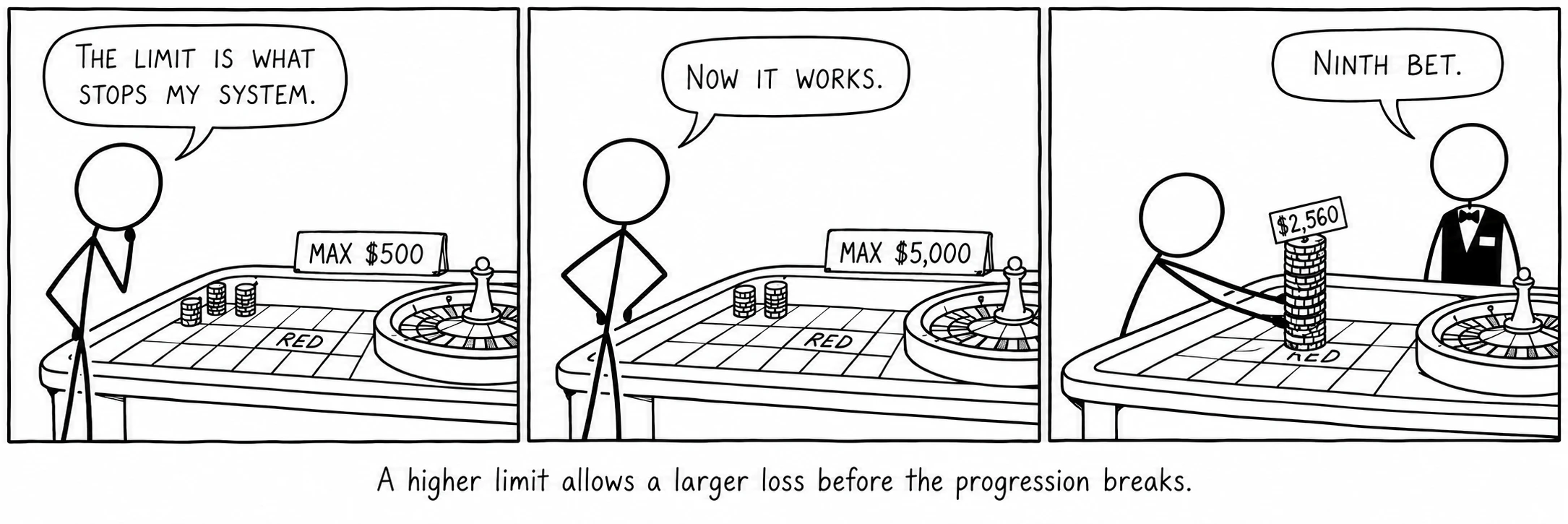
Zvisingawanzoitiki asi zvikuru, pamuganho wega wega. Chigadzirwa hachichinji.
Zvinyorwa
- Ethier, S. N. The Doctrine of Chances: Probabilistic Aspects of Gambling.
- Thorp, E. O. “Optimal gambling systems for favorable games.”
- Thorp, E. O. The Mathematics of Gambling.
- Epstein, R. A. The Theory of Gambling and Statistical Logic, 2nd ed.